
Prefer to watch the YouTube video? Click Here
Caroline Walsh was 84 years old in 1831. She had fallen on hard times and had to make money by spending hours walking the streets selling ribbons and threads. When her neighbours, Elizabeth Ross and her common-law husband Edward Cook, moved and invited her to join them, she reluctantly agreed. That decision would prove deadly. The anatomists working in the hospitals required bodies to carry out their studies, and Edward already had a reputation for body snatching.
It would be the testimony of Elizabeth’s own 12-year-old son, Ned, that would uncover what had become of Caroline.
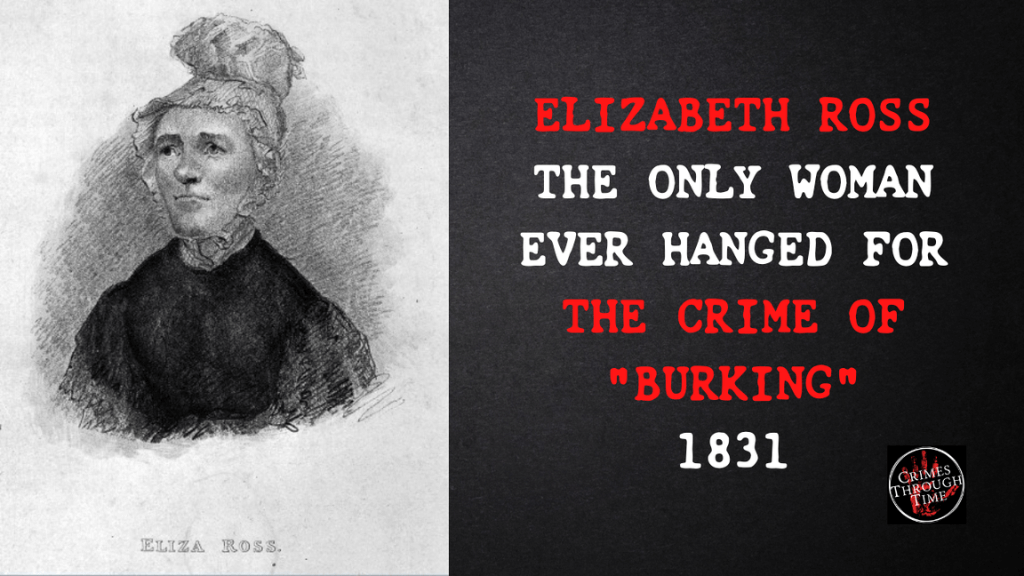
Let’s explore how Elizabeth would become the only woman hanged for the crime of “burking”, murdering a person with the intention to sell their body.
To say Elizabeth Ross had a bad reputation would be an understatement. Unable to keep a job for long because she was a prolific thief, she made money skinning hares, although it had been noticed that wherever Elizabeth lived, the local cats would disappear under suspicious circumstances. She was known to enjoy Gin, which turned her violent and foul-mouthed. She was described as quote “a large, raw-boned, and coarse-featured Irishwoman who has been many years known about the east-end of the town and remarkable for her bad habits and violent disposition.” End Quote
Her common law husband, Edward, was no better. A body snatcher with an equal affinity for alcohol as Elizabeth. He was a bully, easy to anger and quick to throw punches.
Caroline Walsh first met Elizabeth, Edward and their 12-year-old son Ned when they lived next door to her and her granddaughter Ann Buton in Red Lion Square, London. The Cooks would then move to 7 Goodman’s Yard and invited Caroline to join them. Ann thought this an odd request; they, after all, were nothing more than acquaintances. Ann tried to talk her out of going, but to no avail.
Later neighbours at Goodman’s Yard would recall Caroline arriving at number 7 on the 19th August 1831; no one would recall her leaving or ever seeing her alive again.
In October 1831, Ann Buton walked into the Lambeth Street Police Office to report her grandmother missing
Ann had called at the Ross residence many times over the intervening months to be told she had every time quote “gone out” end quote. On one occasion, she even took Elizabeth to Brown’s Pub, where they drank gin and 2 pints of beer. Ann tried to get Elizabeth to talk about the whereabouts of Caroline, but it just resulted in Elizabeth accusing Ann of implying she had done something to Caroline, but also declared that she would soon find out what had happened to her grandmother.
After checking the jails, poor houses and hospitals, Ann became certain something awful had happened to Caroline and that Elizabeth and Edward were behind it.
Officer James Lea accompanied Ann to the Ross house. He asked Elizabeth for her account of the day Caroline arrived at Goodman’s Yard. She stated that Mrs Lydia Basey, Ann’s sister, had brought her to the rooms. They had a lovely evening, talking and laughing over a supper of cold meat and coffee before they all retired to bed at 9 pm. Lea then took Elizabeth to the dock where Edward was working and asked him the same question. He stated that they had eaten hot meat and drank tea before going to sleep at 11.15 pm. This inconsistency was enough for the pair to be arrested. Lea also went to the local charity school and arrested Ned.
Once in custody, Ned was agitated and upset, and the master and mistress of his school were sent for, and it was to them that he gave a full account of the murder of Caroline Walsh.
The trial began on the 6th of January 1831, Mr Adophus for the prosecution, Mr Barry and Mr Churchill for the defence. The main witness for the prosecution was Ned, who took the stand to testify against his parents. Mr Justice Park presided
Ned couldn’t remember the exact date, but he recalled a Friday night when an old lady came to the household, and they had taken coffee before going to bed. During the night, he heard Elizabeth go to Caroline. He saw her place one hand over her mouth and one on her chest and hold it there for half an hour. Edward was also present, but stood looking out of the window with his back to the women.
Elizabeth then carried Caroline’s body to the cellar. Ned returned to bed and rose as normal the next day for school. A friend of his kept ducks in the cellar, and before leaving that morning, he went to check on them and saw the body in a sack. He went straight to school and didn’t speak a word to anyone.
Elizabeth called out from the dock quote “ Good God! How could I have borne a son to hang me!” End quote. Ned burst into tears and said he was only telling the truth.
He said that it was on Sunday that his mother told him she had taken the body to the hospital. Ned was asked if there had been any arguments between the adults on Friday night, and there hadn’t been; both Edward and Elizabeth had been on good terms with Caroline.
This set up the motive for the murder as “Burking”, named after the famous body snatchers turned murderers William Burke and William Hare, who were active in Edinburgh between 1827 and 1828. Suffocation was the preferred method as it did the least damage to the corpse, and the body was then taken to the hospital and sold to the doctors for experimentation.
Ned was very careful to point out that his father did not participate in any part of the crime. But it would have been Edwards’ connections that would have bought the body, and he was present and did nothing to prevent it, so not an innocent person by any stretch.
Witnesses were brought from the Rag Fair on Rosemary Lane, who testified to Elizabeth selling them clothing in throughout October. These items, when bought to court, were identified as Caroline by her granddaughter’s Lydia and Ann. Ann had even made some of the clothes herself.
Elizabeth would say that Ann had gifted the items to her, but this was vehemently denied.
The defence claimed that Ned had been coached and that his testimony was unreliable, quote “she (Elizabeth) accused the boy of having uttered falsehoods respecting her, and prayed to God to forgive him for having done so.” End quote.
They questioned how a body could lie undiscovered for over a day in a communal cellar. The landlady would answer this question by saying that they had a rat infestation, and the cellar being very dark, even in the day, people avoided the cellar and would very rarely go down there.
As Caroline’s body wasn’t recovered, could she still be alive, as well as saying she died much later than August in Tibble’s Poor House? An old lady had died there, named Catherine Walsh, who was between 60 and 70 years old, with no front teeth. This couldn’t have been a mis-recording because Caroline Walsh had all her teeth present and was 84 in 1831.
The jury took just 15 minutes to find Elizabeth guilty and to acquit Edward, although he would remain in custody, with the judge saying quote “the person who aided and abetted another in the commission of the crime was a principal in the second degree. There was no question of an accessory after the fact in the present case.” Edward would be tried and convicted of these further charges.
Elizabeth would protest her innocence, saying she had been made a scapegoat for a mysterious “Gentleman”.
She was hanged on Monday, the 9th of January 1832, at the Debtor’s gate at Newgate prison.
A fact that Elizabeth could not believe was happening. Quote “Oh, my God! Am I going to be hanged for what I am innocent of? … Oh, my God! Why did I leave my country to be so treated? … I left my husband and boy sitting with the old woman, and I never saw her after. You have now in your custody one who can prove me innocent, and quite clear me of the charge. Oh, my poor, my deluded child!” End Quote
Her body was then given to the anatomists to dissect, and a drawing was made of Elizabeth after death by anatomist Dr William Clift.